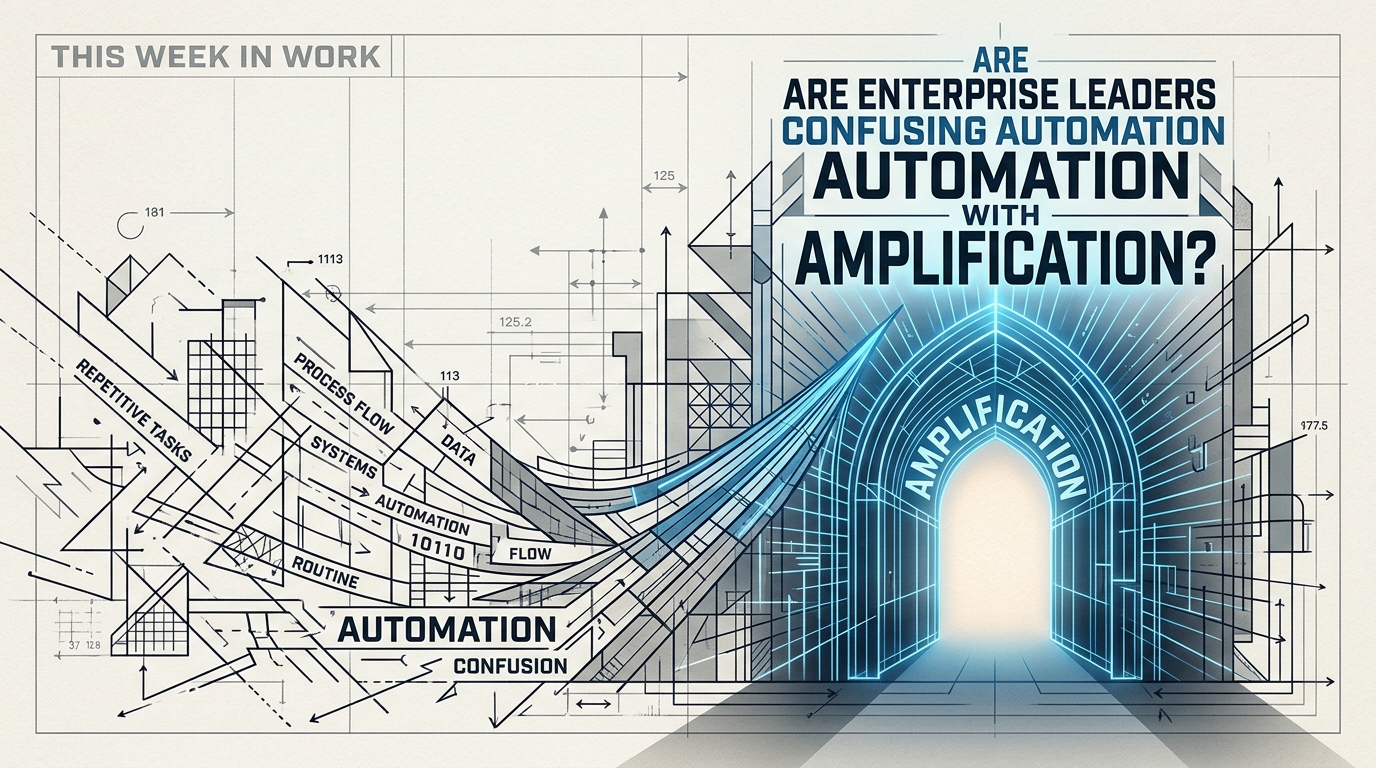
Are enterprise leaders confusing automation with amplification?
Slashing headcount to pocket quick AI savings is proving to be a costly miscalculation. True enterprise advantage lies in amplifying capability rather than hastily removing humans from the loop.
The executive instinct to treat every technological wave as an eviction notice for human staff is once again hitting reality. Across boardrooms, the initial fantasy of autonomous systems quietly running entire departments without human friction has run into the stubborn complexity of operational work.
The cost of hasty subtraction
A striking forecast from Gartner research predicts that by 2029, 30% of employees laid off due to replacement by AI will need to be rehired. The core error, as analyst Tori Paulman observes, stems from "believing that work automation was the point, when workforce amplification was the opportunity." When firms abruptly strip institutional knowledge out of a workflow, they invariably discover that the messiest, most valuable components of enterprise problem-solving were never written down in the standard operating procedures.
Rather than eliminating workers, high-performing organisations are simplifying the underlying work before introducing autonomous software. Fresh field evidence from a Microsoft workflow analysis documented a 75% reduction in cycle times across selected processes—underpinned by a cardinal rule: eliminate institutional bottlenecks first rather than bolting algorithmic agents onto broken structures.
Supervision over substitution
The rush to hand operational reins to autonomous agents has also outpaced common sense. According to the latest Deloitte report, while agentic AI adoption is poised to surge, only one in five companies possesses a mature governance model for supervising autonomous systems. Advanced enterprises are recognising that while agents can sequence and execute multi-step routines, humans must retain command of judgment, exception handling, and strategic oversight.
When the dust settles on this transition, will your balance sheet reflect genuine transformation, or merely the expensive tuition fees of rehiring the expertise you discarded?