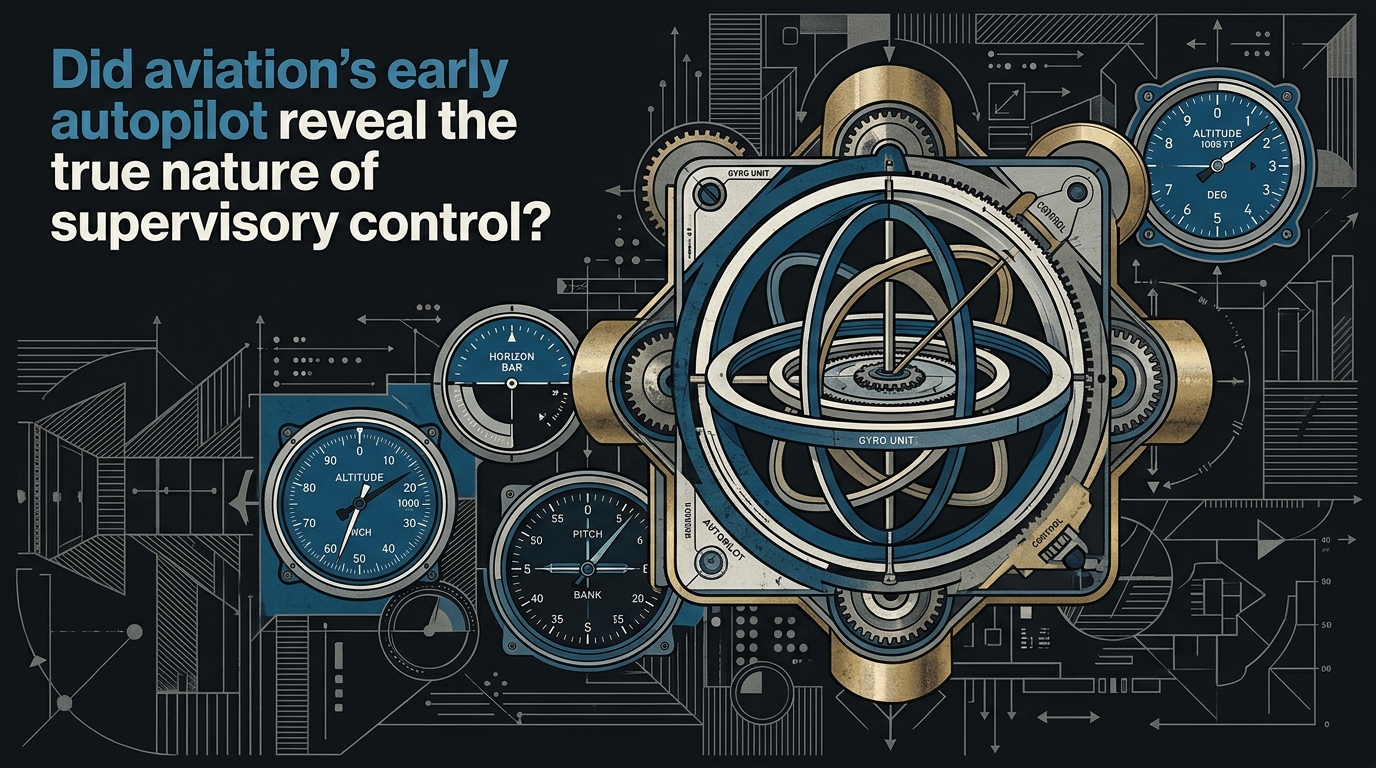
Did aviation's early autopilot reveal the true nature of supervisory control?
When automatic gyroscopic steering arrived in the cockpit, sceptics assumed human pilots were obsolete. Instead, flight crews evolved into system orchestrators whose primary duty was vigilant diagnosis.
In June 1914, American inventor Lawrence Sperry stunned spectators over the Seine by standing upright in the cockpit of a Curtiss flying boat with both arms raised high, while his mechanic walked out onto the wing. The craft flew on level and undisturbed, guided by Sperry's gyroscopic stabilizer. Decades later, when the Sperry Model A-3 autopilot became standard equipment on commercial airliners like the Douglas DC-3, industry observers predicted the imminent extinction of the commercial aviator. The logic seemed airtight: if an apparatus could maintain heading and trim far more precisely than human muscle, flesh-and-blood pilots were an expensive anachronism.
The supervisory paradox
Aviation history told an entirely different story. The autopilot did not eliminate airmen; it transformed their professional discipline. Relieved of continuous physical strain on the yoke, pilots stepped back into the role of supervisory commanders. They became systems monitors, scanning dials, tracking barometric changes, navigating weather patterns, and managing fuel reserves. Far from diminishing their craft, mechanical delegation required higher cognitive acuity: the airman had to understand the machinery intimately enough to know precisely when to intervene.
Calibrating the human loop
Today's workplace is confronting an identical transition. As described in Deloitte's analysis of agent orchestration, enterprise systems are introducing a progressive autonomy spectrum—shifting workers between operating in the loop, on the loop, and out of the loop depending on task volatility and operational criticality. Much like early transport pilots who realised that disengagement degraded flying reflexes, the Microsoft Work Trend Index records that 43% of leading professionals now deliberately perform complex tasks manually to preserve their sharp diagnostic judgment.
Flight safety did not advance by pretending the machine could never fail, but by training crews to govern its limits with quiet authority.
As your digital co-pilots assume the controls, are your teams practising how to fly the plane when the instruments go blind?