Did container shipping already solve our workflow puzzle?
Faster cargo vessels yielded negligible economic gains until dockyards abandoned hand-loading for standardised boxes. Today’s algorithmic bottlenecks mirror the freight revolution of the 1950s.
In the mid-twentieth century, naval architects designed ever-faster ocean liners and freighter vessels to speed up global trade. Yet transoceanic commerce remained stubbornly sluggish and expensive. The problem was not nautical speed; it was the dock. For decades, cargo arrived in idiosyncratic sacks, barrels, and crates, requiring gangs of stevedores weeks to load and unload a single hull by hand. The ship was extraordinarily fast, but the surrounding process was chained to the nineteenth century.
The modular breakthrough
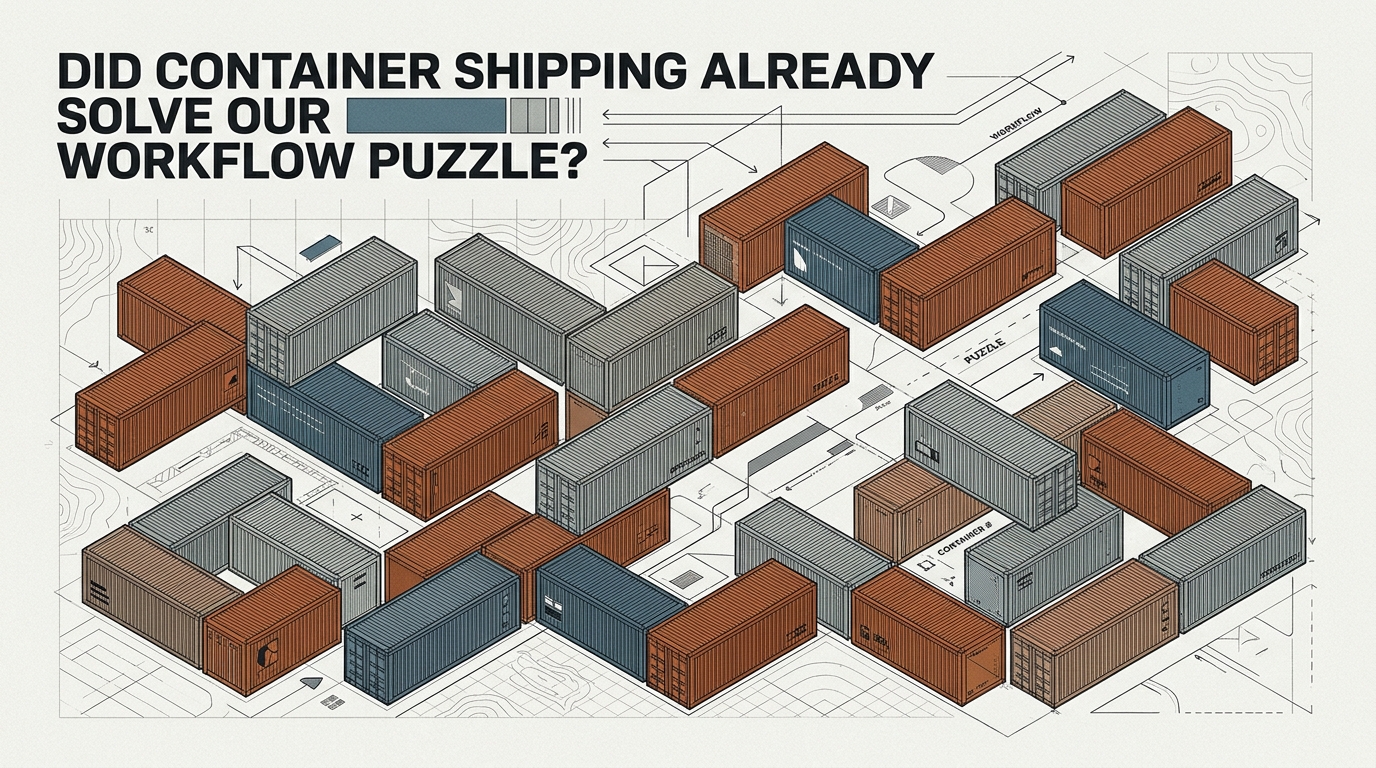
The solution arrived in 1956 when haulage entrepreneur Malcom McLean championed the intermodal shipping container: a uniform, corrugated steel box that detached cleanly from a lorry chassis and slotted straight into a crane-equipped hold. The vessel itself was almost secondary. What transformed global commerce was redesigning the interfaces, cranes, rail yards, and packing workflows around a single standard unit of transfer.
A remarkably similar dynamic is unfolding across knowledge work today. As Microsoft observes, enterprise technology has advanced from answering ad-hoc queries to executing complex, multi-stage workflows. Yet modern operations frequently stumble because organisations attempt to pour autonomous capabilities into fragmented email chains, unstructured chat channels, and rigid committee reviews.
Strategic analysts at BCG emphasise that technology investment yields little until firms establish an updated operating model combining human personnel and autonomous systems. Likewise, Gartner reports that 78% of human resources leaders recognise that roles and workflows must fundamentally transform to capture genuine value from these tools.
Much like the shipping giants who initially resisted altering their piers, firms clinging to legacy coordination methods will find their new digital engines largely stranded at the quay.
Are you building faster steam engines, or have you finally started building the crane?