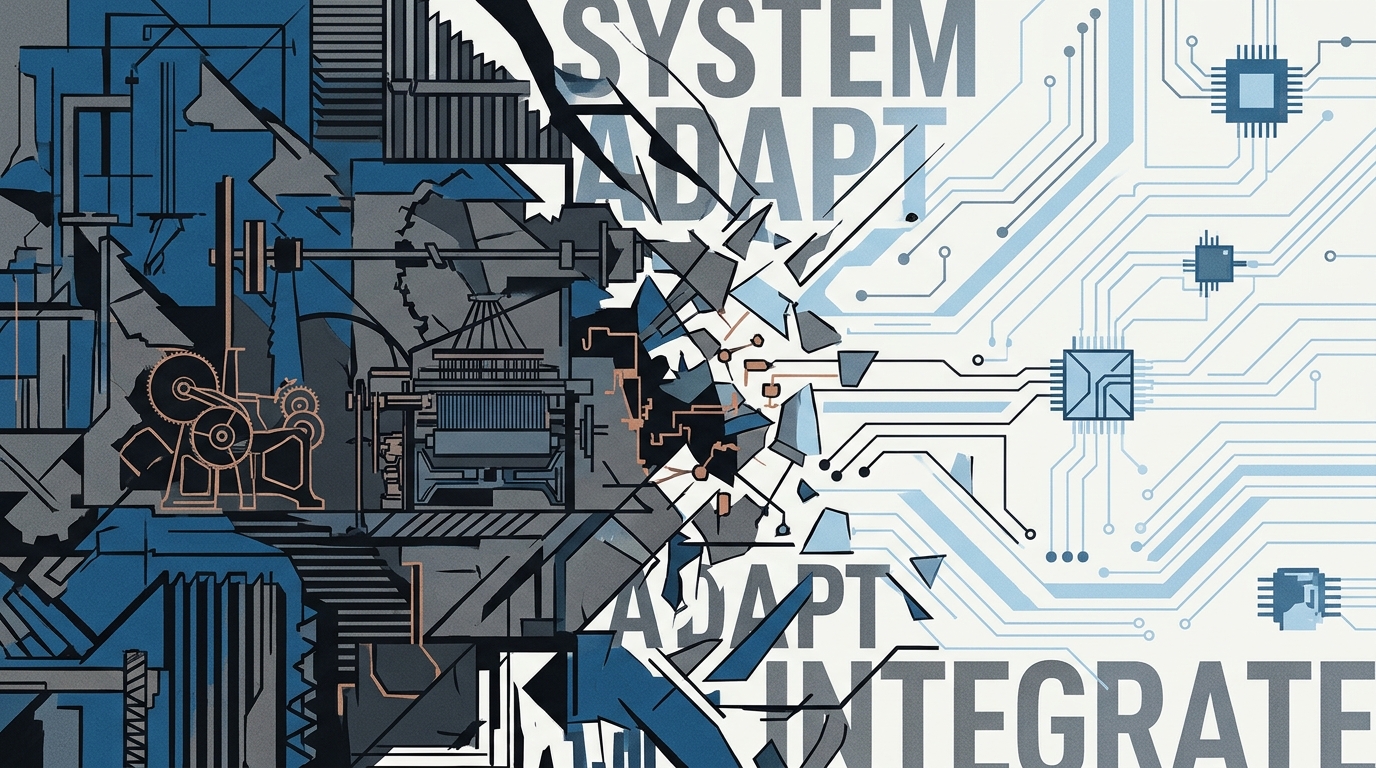
Did early factory electrification already expose the fallacy of the direct drop-in?
When Victorian mills first adopted electric dynamos, manufacturing productivity stubbornly stalled for decades. Real progress arrived only when industrialists reimagined the entire layout of physical production.
In the late 1890s, industrial factory owners believed they had solved manufacturing efficiency forever. They unbolted their roaring central steam engines and substituted massive electric motors in their place. Yet for nearly thirty years, industrial output remained largely flat. Mill operators had kept the traditional multi-storey masonry, the intricate maze of leather ceiling belts, and the dangerous overhead drive shafts completely intact. Electricity had been treated as a simple fuel substitute rather than an invitation to redesign the workshop.
The trap of the one-to-one swap
Breakthrough productivity finally emerged in the 1920s when managers stopped copying the steam layout. They dismantled the overhead pulleys, installed independent fractional motors on individual workbenches, and flattened factories into single-storey assembly lines where materials flowed without friction.
Today's enterprise software transition echoes this exact mechanical misjudgment. Analysts at Gartner forecast that by 2029, thirty per cent of employees laid off due to AI replacement will need to be rehired, cautioning that executive leadership's greatest error lies in viewing autonomous technology as a mechanism for head-count subtraction rather than human amplification.
Rethinking the operating model
The modern equivalent of the overhead steam belt is the bloated approval chain. Analysis by McKinsey emphasizes that the emerging operating model demands workflows rebuilt from first principles, where squads of agents execute tasks whilst people steer, validate, and set intent. As practical findings in the Microsoft 365 Blog reinforce, sustainable gains come from simplifying how work proceeds before automating, rather than superimposing algorithms onto fractured heritage systems.
Technology yields its dividend only when leaders have the courage to dismantle the ceiling pulleys.
Are you building modern operational flow lines, or just electrifying the old steam belts?