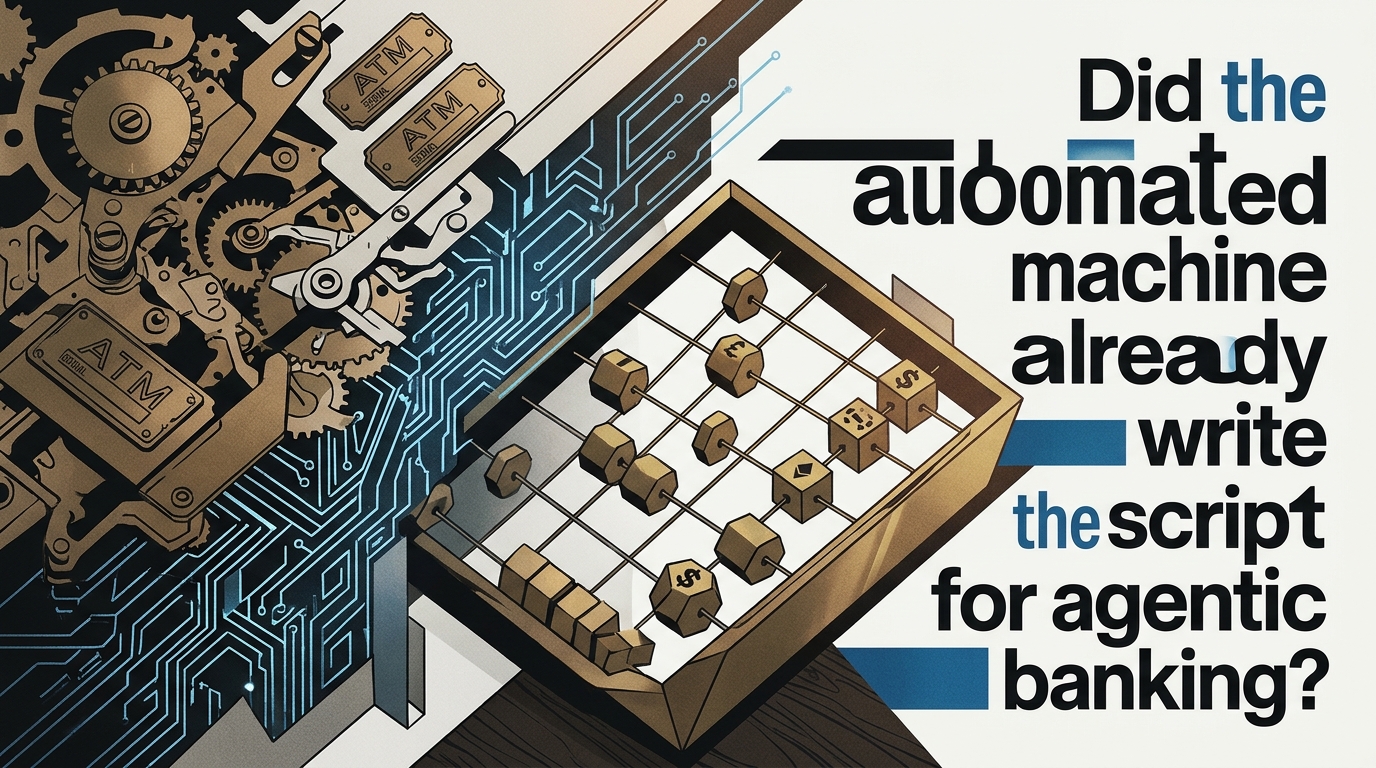
Did the automated teller machine already write the script for agentic banking?
When automatic cash machines first lined British high streets, observers predicted the swift demise of bank branches. Instead, decoupling staff from repetitive counting triggered an era of higher-touch advisory service.
In June 1967, Barclays unveiled the world’s first automated teller machine at its Enfield branch. The mechanical dispenser, activated by sixpenny vouchers, ignited intense anxiety among banking staff. Industry observers confidently predicted that automated cash handling would hollow out local retail networks, leaving bank clerks obsolete within a decade.
The Paradox of the Cash Dispenser
The reality defied every pessimistic forecast. By automating the purely mechanical task of counting banknotes, financial institutions drastically lowered the cost of opening and maintaining individual branches. Freed from handling routine currency, bank clerks transformed into relationship officers, mortgage advisers, and commercial underwriters. Over the subsequent quarter-century, branch networks expanded, and overall bank employment grew alongside rising customer service expectations.
That historical parallel is instructive as modern financial institutions reconsider their operational design. A recent McKinsey briefing on agentic banking systems demonstrates that the current wave of collaborative software coworkers demands new frameworks for governance, architecture, and accountability rather than simple head-count reduction.
Diffusion Over Pure Invention
The enduring lesson of early banking automation is that mechanisation only succeeds when coupled with structural redesign. As Professor Erik Brynjolfsson observes in the World Economic Forum’s research on organizational transformation, the true bottleneck in the modern digital economy is never technical invention, but social diffusion and organisational restructuring.
Rushing to cut headcount without reconsidering the customer experience repeats the old error identified by Gartner’s workplace researchers: treating technology as an instrument of subtraction rather than an engine of amplification.
Are you using modern computational power to eliminate administrative payroll, or to cultivate client relationships your competitors cannot replicate?