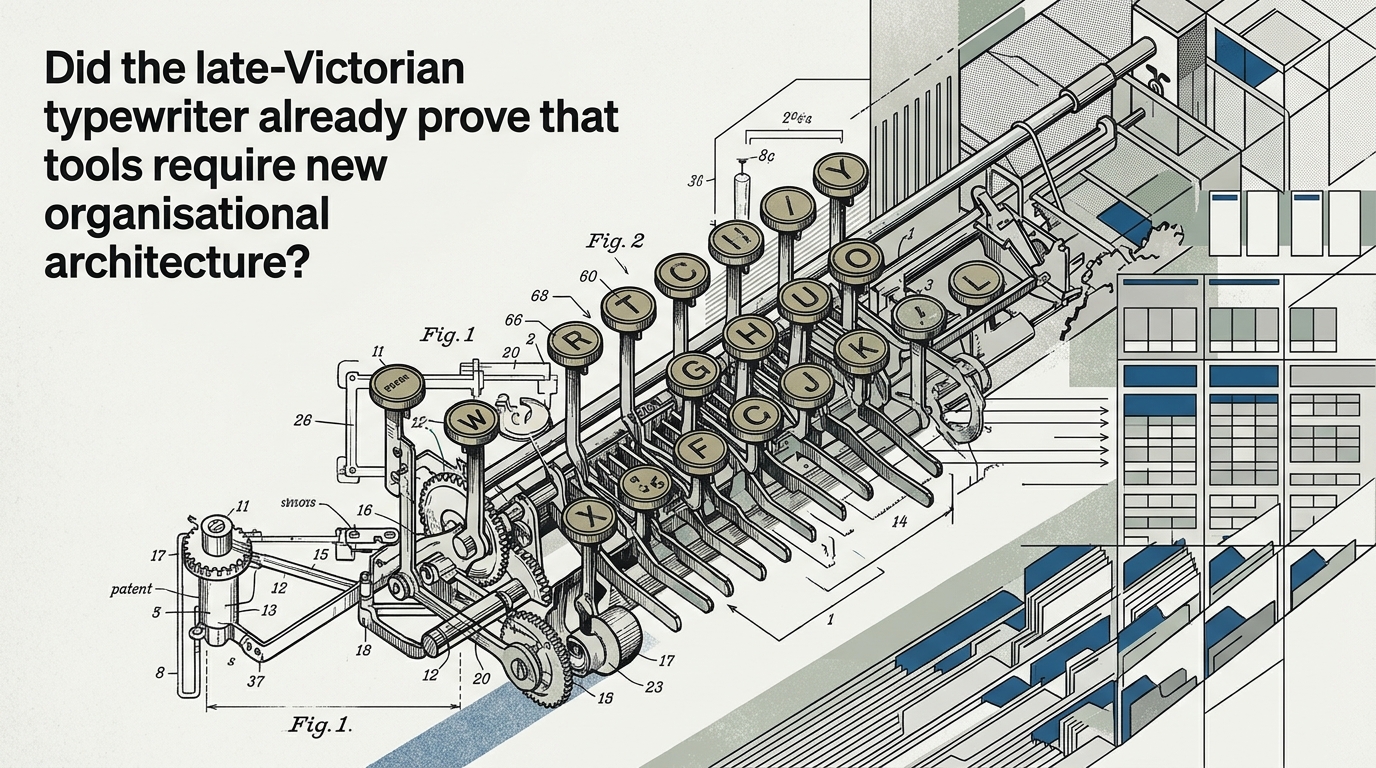
Did the late-Victorian typewriter already prove that tools require new organisational architecture?
When mechanical typing entered Victorian commercial offices, executives imagined it simply as a faster quill. In reality, realizing its promise required the complete invention of the modern filing system.
When Christopher Latham Sholes and E. Remington & Sons brought the commercial typewriter to British and American counting houses in the 1870s and 1880s, corporate leadership greeted it with a singular, unimaginative assumption: here was a slightly swifter fountain pen. Executives calculated mechanical typing speeds, anticipated modest clerical payroll savings, and expected business to proceed precisely as it always had.
The trap of the drop-in tool
The early results were notoriously underwhelming. Placing a mechanical writing machine into an office structured around leather-bound ledgers, copperplate handwriting, and mahogany pigeonholes produced little more than noisy confusion and irritated partners. Clerks produced duplicate correspondence at unprecedented velocity, only to watch it pile up in chaotic drifts across Victorian counting rooms.
Real value emerged only when enterprises recognised that a ten-fold increase in text production necessitated an entirely fresh operational architecture. The typewriter did not transform commerce on its own; it forced the simultaneous invention of carbon paper workflows, vertical suspension filing cabinets, standardised decimal indexing, and distinct administrative secretarial tiers. The hardware was merely the spark; the reorganisation was the fire.
The historical law of diffusion
This historical pattern directly mirrors our modern moment. As economist Erik Brynjolfsson observes in research published by the World Economic Forum, the fundamental bottleneck in the digital economy is rarely invention; it is diffusion. Similarly, BCG emphasises that in major digital transformations, fully 70% of realised value derives from rethinking people and organisational structures, with technology accounting for a minor fraction.
The Victorian clerks who thrived were not those who tried to emulate copperplate penmanship on mechanical keys, but those who mastered the new filing systems and structured office protocols. Technology delivers return on investment only when leaders cease substituting new contraptions into decaying routines, and muster the courage to redesign the office floor itself.
Are we modernising our enterprise workflows today, or merely typing faster into nineteenth-century filing drawers?