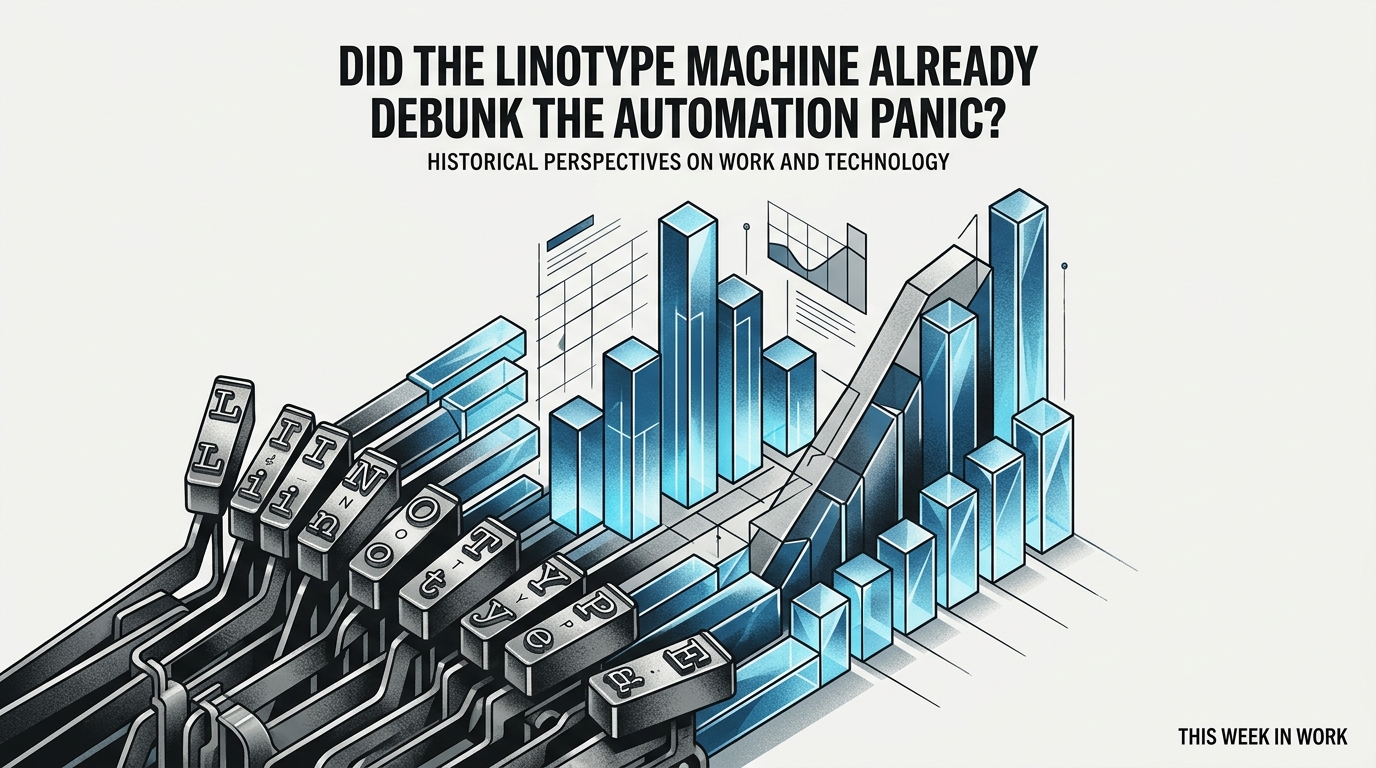
Did the Linotype machine already debunk the automation panic?
In 1886, printers feared that mechanized typesetting would wipe out an entire trade overnight. Instead, it triggered an information explosion that created more jobs than it consumed.
In July 1886, when Ottmar Mergenthaler unveiled the Linotype machine at the New York Tribune, the printing industry trembled. For four centuries, the printed word had depended on compositors painstakingly plucking individual lead characters from wooden cases, one letter at a time, to assemble columns of text. Mergenthaler’s keyboard-operated contraption cast entire lines of type from molten metal in seconds. To the trade unions of Fleet Street and Manhattan, it looked like an industrial guillotine.
The mechanics of an information boom
The predicted mass unemployment never arrived. By slashing the marginal cost and time required to set a page of type, the Linotype altered the economics of publishing entirely. Newspapers that previously struggled to produce eight daily pages suddenly expanded to 64 pages to satisfy an information-hungry public. Afternoon editions multiplied, niche periodicals flourished, and classified advertising exploded.
Far from being cast out, compositors retrained as skilled Linotype operators. Total employment across the printing, editorial, and advertising sectors surged over the ensuing two decades. Mechanisation did not extinguish the craft; it unleashed latent consumer demand that manual methods had kept artificially suppressed.
The persistent amplification lesson
Today’s arrival of autonomous agents echoes that nineteenth-century typographic revolution. As modern studies from Gartner research remind us, treating technology solely as an instrument of labour substitution misses the point entirely. The true economic leverage of automation has always been amplification. When the friction of routine execution drops to near zero, the appetite for richer analysis, customisation, and higher-order output invariably expands.
As Microsoft workflow analysis demonstrates, the primary dividend of algorithmic efficiency is cycle-time collapse. Just as the Linotype turned a scarce eight-page daily into an abundant modern press, autonomous tools will likely reveal that our organisations were never overstaffed—merely starved of bandwidth.
Are you using new technology to shrink your organisation into irrelevance, or to unlock demand you previously couldn't afford to satisfy?