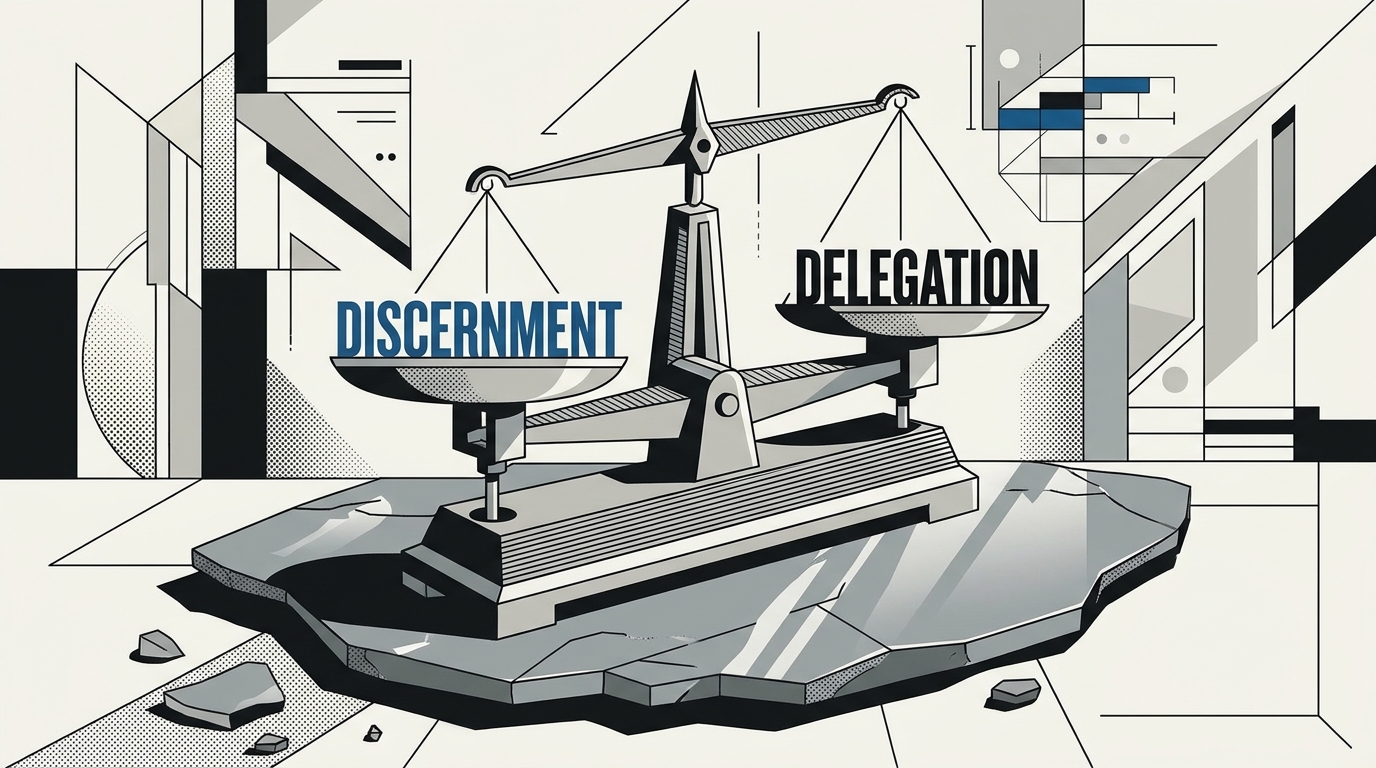
Will autonomous delegation make discernment our most valuable trade?
As digital agents multiply across core enterprise systems, routine execution is becoming cheap and ubiquitous. High-value work now belongs to professionals who can audit synthetic reasoning and govern autonomy.
When execution becomes automated, the premium on judgment rises exponentially. Across global enterprises, digital agents are handling multi-step processes at remarkable speed. According to the Microsoft Work Trend Index, the volume of active agents within enterprise ecosystems has surged fifteen-fold year over year, climbing eighteen-fold inside large corporations. Yet rather than rendering human contribution marginal, this wave is establishing a new agency equation: as software manages the execution, professionals have more room to steer strategy, arbitrate trade-offs, and take accountability for outcomes.
The skills that machines cannot simulate
This structural rebalancing is generating an entirely new operational archetype: the autonomy orchestrator. Rather than producing first-draft reports or manually wrangling data, workers are stepping into supervisory roles across the autonomy continuum. The Microsoft research reveals that when organisations assess the capabilities most vital as AI expands, quality control of synthetic output leads the list at 50%, followed by objective critical thinking at 46%. Crucially, 43% of frontier professionals report intentionally completing certain tasks unassisted simply to maintain their cognitive edge.
This appetite for blended excellence is clearly visible to capital markets. Findings in Mercer's Global Talent Trends report reveal that 72% of investors believe organisations that successfully combine human and artificial intelligence capabilities will secure an enduring competitive advantage.
Bridging the institutional capability gap
The hurdle is not human willingness, but corporate infrastructure. While market demand for hybrid oversight accelerates, the CompTIA Workforce and Learning Trends study notes that only 34% of employers maintain a formal, organisation-wide programme for reskilling current personnel. Those who bridge that gap by teaching people how to evaluate, steer, and govern synthetic work will find themselves possessing the most durable talent pool in modern industry.
When tasks are handled at the touch of a button, will your organisation reward the people who know when not to press it?