Will cross-generational mentoring unlock the true potential of skills-based work?
As static job titles give way to dynamic capability frameworks, forward-thinking employers are reinventing workplace apprenticeships. Cross-generational knowledge exchanges are turning technological change into a powerful cultural unifier.
For decades, corporate progression meant climbing a preordained hierarchy defined by rigid titles and tenure. Today, that static architecture is dissolving in favour of something far more fluid.
According to research highlighted by the World Economic Forum, modern enterprises are increasingly prioritising capabilities over formal credentials, moving toward a framework that liberates employees from the traditional confines of the job description. Rather than slotting individuals into fixed boxes, employers are tracking dynamic competencies that adapt alongside technological change.
The rise of reciprocal coaching
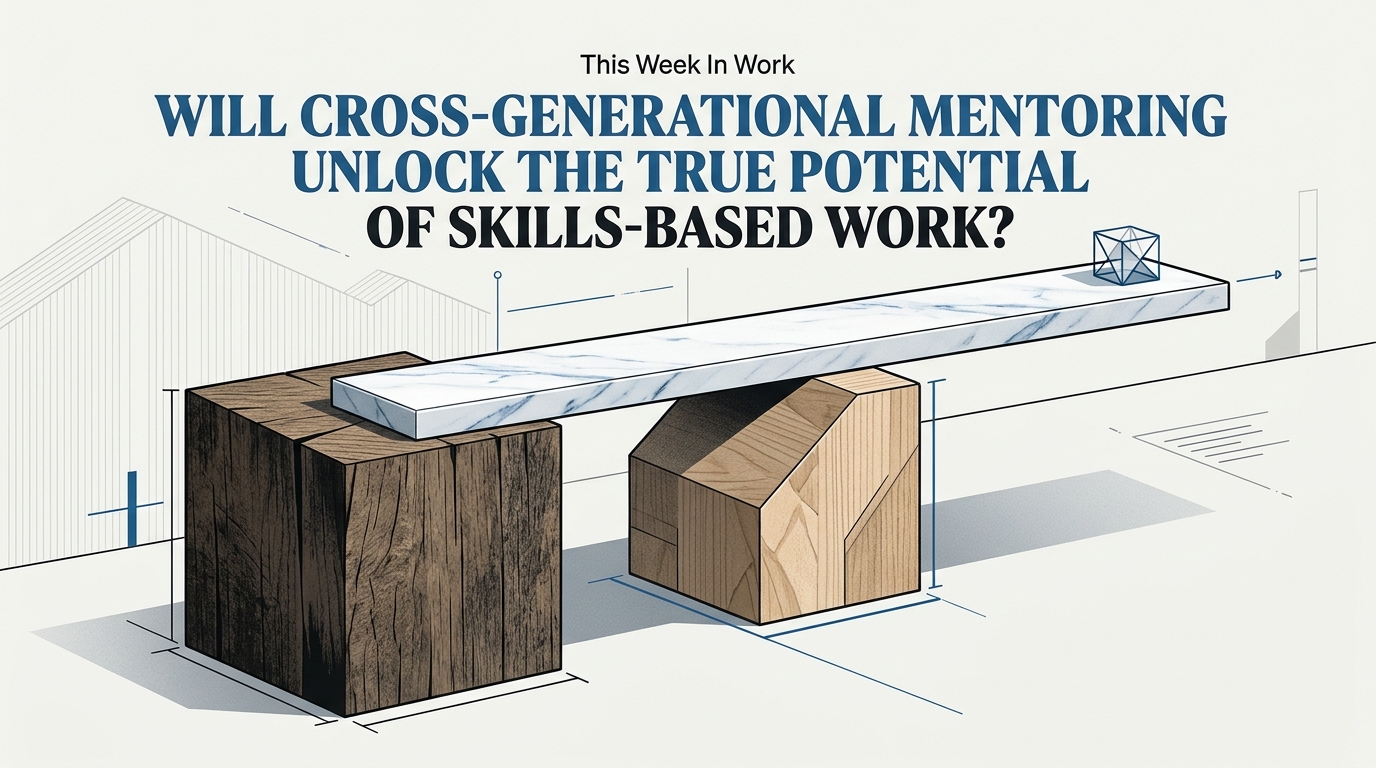
This transition has sparked an unexpected upside for workplace culture: the emergence of reciprocal, cross-generational coaching. Data from IWG demonstrates that digitally confident younger employees are actively assisting senior colleagues with navigating autonomous tools, while tenured staff supply institutional memory and strategic judgment.
Far from creating generational friction, this exchange establishes a mutual reliance. As a global study by Korn Ferry surveying over 1,300 leaders confirms, adaptability has emerged as the single most critical workforce capability. Those who thrive are not necessarily the ones who memorised legacy software, but those who can assimilate new workflows in real time.
Partners in productivity
Analysis in the MIT Technology Review suggests that as autonomous agents take over complex functional execution, the redistribution of workplace responsibilities will accelerate. This evolution elevates human-to-human collaboration: junior staff shed administrative drudgery earlier in their careers, stepping into collaborative roles where curiosity and coaching matter more than years at a desk.
Organisations embracing this approach report stronger internal cultures and resilient teams. When learning flows bi-directionally, the perceived threat of obsolescence yields to shared mastery.
What if the most valuable asset in the modern office is not technical expertise, but the willingness to teach a colleague?